
Finding Cicero Resident Evidence
A Cicero residents directory search is strongest when it starts with an exact name, address, or time period. For a current property question, begin with Onondaga County assessment and tax resources to identify the parcel, then compare the owner label with a recorded instrument from the County Clerk. For a name and registration question, use the state voter lookup only as a dated registration check. A library directory, newspaper, census record, or obituary is often the better route for a former household.
No single record identifies every person who lives in the Town of Cicero. Owners, registrants, court parties, licensees, and historical directory entries are different labels. A tax mailing address can differ from a property address, and a postal result is not proof of a household. Keeping those labels beside each result makes a Cicero search more useful and less likely to overstate what the record says.
- Preserve the name or address as written, with its postal-city label and approximate date.
- Use county property or tax tools to identify a parcel, owner label, or tax-map reference.
- Check the County Clerk’s recorded-document route for deed parties and a legal description.
- Use the state voter lookup for a lawful individual registration check.
- For older names, use OCPL collections and County Clerk Archives before making a narrow records request.
Note: Record the source date and its role, such as owner or historical entry, before comparing it with another Cicero record.
Cicero Resident Records Offices
Town of Cicero records and Onondaga County records are kept by different custodians. The Town Clerk receives local FOIL requests and the zoning office holds permit material. County offices maintain the land, assessment, election, and vital-record channels that often form the practical Cicero residents directory. The County Clerk’s real-property materials reach back to 1794, although online index and image availability varies by document. For the full by-address sequence, use the Cicero street directory.
Real Property Tax Services
421 Montgomery St., 15th Floor East
Syracuse, NY 13202
315-435-2426
Onondaga County Board of Elections
1000 Erie Blvd. West
Syracuse, NY 13204
315-435-8683
Town Hall is the right route for a Cicero form, local permit question, or request to the Records Access Officer. County and state tools do not replace a town record that has not been placed online.
Cicero Property and Deed Trails
Property research starts with the parcel, not a conclusion about occupancy. Onondaga Image Mate offers a public-access gateway and advises people to start with as little search criteria as possible. The county also links Beacon, tax maps, assessment rolls, and a tax search. Assessment information comes from town assessors and may not be final until the town’s final assessment roll, generally around July 1.
Once a parcel is identified, the County Clerk’s deed and mortgage records can tie a recorded party to an ownership event. The clerk says county land records reach to 1794, but the research did not confirm that all historical records have a public online image. A deed records a transfer. It does not identify every person at an address, and an easement or mortgage does not automatically show a transfer of title.
- Parcel
- A mapped unit of land used by assessment and tax systems.
- Situs address
- The physical location assigned to a parcel, which can differ from an owner’s mailing address.
- Grantor and grantee
- The party conveying an interest and the party receiving it in a recorded instrument.
- Index
- A finding tool that points to a record, not necessarily the document image.
Note: A final assessment roll and a recorded instrument answer different questions, so retain both dates in a Cicero property trail.
Cicero Voter Lookup Fields
The New York voter lookup is an individual registration tool. It requires JavaScript and cookies, and its visible search asks for county, last name, first name, date of birth in MM/DD/YYYY format, ZIP Code, address information, and a Search action. Required controls are marked with an asterisk. The full address-control behavior and result layout were not retained in the research, so a result should be read only as the state interface presents it.
| Field or control | Format | How it narrows a Cicero search |
|---|---|---|
| County | Dropdown | Selects the Onondaga County context. |
| Last and first name | Text fields | Separates likely name matches. |
| Date of birth | MM/DD/YYYY | Helps distinguish people with similar names. |
| ZIP Code and address information | Search controls | Supports an individual address-based registration check. |
New York’s public voter-list rules and the web lookup are not the same thing. Bulk voter-file requests have an elections-purpose requirement, and protected registrations are exceptions. A registration record should not be described as proof that someone presently occupies a Cicero address.
Current Cicero Resident Directories
Current entries in a Cicero residents directory are really a set of purpose-built public sources. Assessment and tax tools can show a property connection. Recorded documents identify parties to an ownership event. Registration, court, professional, and business tools each cover narrower subject areas. Matching a name across two sources with different purposes is more reliable than assuming that one result settles a current-residence question.
| Source | What it can show | Custodian | Access route |
|---|---|---|---|
| Assessment and tax tools | Parcel, owner label, values, and tax context | Onondaga RPTS and town assessors | Online resources and office route |
| Recorded land documents | Grantor, grantee, legal description, and recording event | Onondaga County Clerk | County page, portal, or counter |
| Voter lookup | Individual registration information presented by the state | New York State Board of Elections | Official web lookup |
| Town permits and forms | Address, application type, and project trail | Town of Cicero | Forms, records request, or office |
| Historic collections | Dated household, business, or community association | OCPL and County Clerk Archives | Library or archive access |
When the goal is to verify one person rather than investigate an address, the Cicero resident lookup uses a separate name-to-record workflow. Its results still need a source label and date.
Cicero FOIL and Permit Files
The Town of Cicero forms hub is the local starting point for a FOIL request, permit materials, complaints, and assessor address or name-change forms. The form route identifies Town Clerk Tracy Cosilmon as Records Access Officer. A useful request names the record type, address, tax-map number when known, owner or applicant name when known, and a narrow date range. The research did not establish a town-specific copy-fee schedule or response timetable, so current instructions on the form control.
Cicero’s forms page shows the local request and application routes.
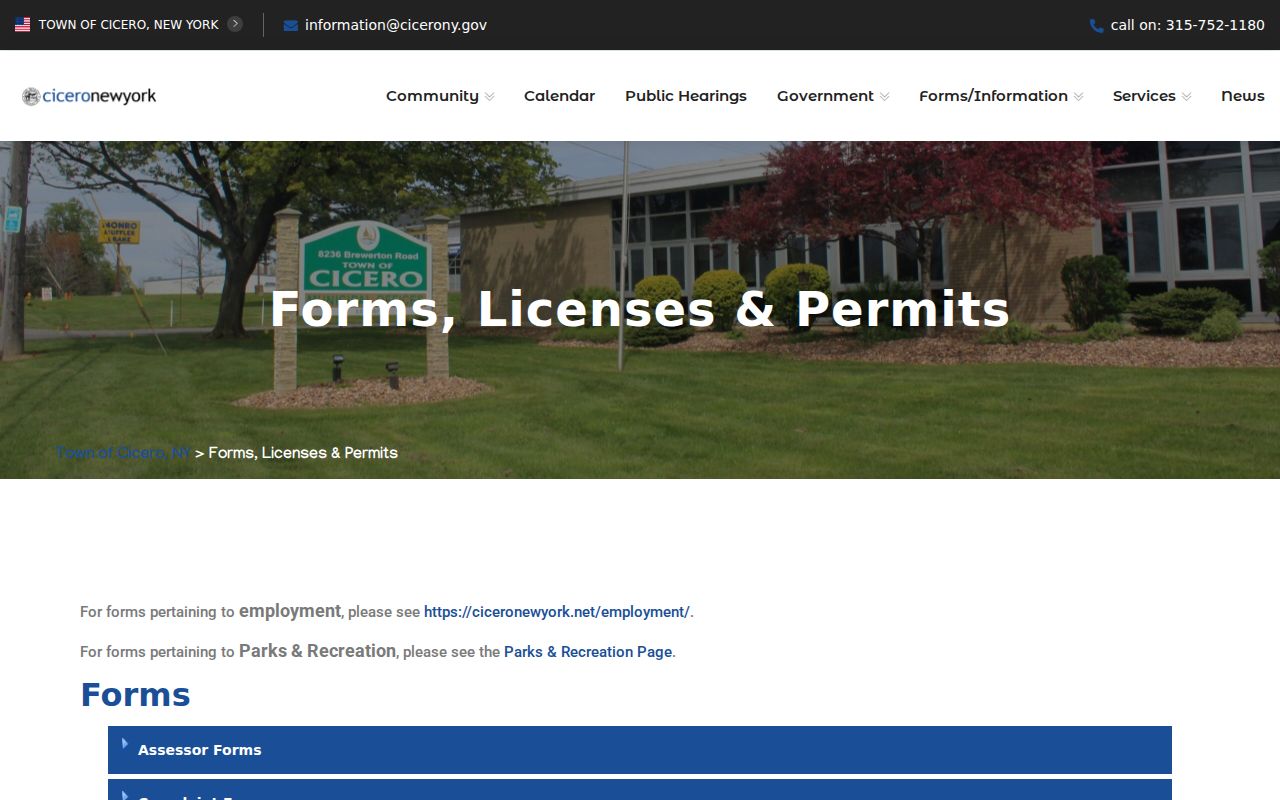
The form hub helps separate a records request from a zoning or permit application. Permit applications are delivered in person, by USPS, or to the drop box, not by email, according to the town guidance.
Building and zoning files can document a physical change, project date, or applicant or owner name. They do not create a general list of households. For an address request, identify the permit category and time window rather than asking the office for every record connected to a street.
Cicero Address and Postal Labels
“Cicero” can refer to the town, a postal-city label, a road or business name, or a historical location. The official county ZIP map places 13039 in central and southern Cicero, while nearby 13029 and 13041 are shown in surrounding postal geography. That map is useful for orientation only. It cannot establish that every address with one of those ZIPs lies within the Town of Cicero.
USPS ZIP Code Lookup standardizes an address and offers address, city-and-state, and ZIP search modes. USPS says a ZIP result does not confirm a person or company at an address. Keep a source’s original postal label, then compare it with county GIS, a parcel record, or a legal description when a municipal boundary matters.
Note: Separate postal matching from parcel matching so an address result is not mistaken for proof of a Cicero household.
Cicero Military Tract Clues
Local history gives older searches a useful place-based frame. The Town of Cicero says the Military Tract was surveyed in 1790 into 100 lots of roughly 600 acres. Cicero was erected in 1807, then separated from Clay in 1827. An early record may therefore use a Clay or historical jurisdiction label even when the land sits in modern Cicero. A legal description, tract reference, map, or old directory can be more helpful than a modern street name for that period.
Cody’s Corner is another documented local search phrase. The town history connects it with Isaac Cody’s tavern, store, and postmaster role. That makes it a useful lead for county histories, postal references, maps, and historical directories, but a business or place reference must not be turned into a claim about a person’s residence.
Historical Cicero Resident Directories
Older Cicero residents directory material is held primarily in regional collections, not in a modern town database. OCPL Local History and Genealogy has directories, newspapers, census resources, cemetery cards, maps, obituary indexes, and phone books. County Clerk Archives adds historical directories, tract maps, naturalization material, census resources, and 1938 aerial maps. These sources can place a household, business, or community presence in a particular period without proving continuous residence.
OCPL’s exact holdings include Cicero & Community for 1993; North Syracuse-Cicero for 1957 and 1959; and Onondaga County Rural for 1917 through 1922. The library also holds county directory runs from 1868-69, 1878, 1887, 1891-92, 1896, and 1899. The full shelf, search, and access details belong on the Cicero city directory page.
Note: A dated directory entry is historical evidence, not a statement that the listed person still lives in Cicero.
Cicero Directory Shelves at OCPL
OCPL Local History and Genealogy is on the Central Library’s third floor in Syracuse. The collection requires a valid OCPL card, and a nonresident card is available at the welcome desk. Listed hours are Monday, Thursday, Friday, and Saturday from 9 to 4:45; Tuesday and Wednesday from 9 to 7:15; and Sunday closed. Check the library before a special trip, as access details may change.
Its companion source list points researchers to city and statewide directories, selected Sanborn maps, federal and New York census material, the Onondaga Pioneer Index, and a Syracuse newspaper obituary index covering about 1860 to 1996. The NYG&B collection adds OCR-searchable Onondaga histories and directories, with first name, last name, exact-spelling, and keyword fields. OCR is a starting point, not a substitute for reading an original volume or noting its year and page.
Cicero Protected Address Limits
Some missing results are intentional. New York’s Address Confidentiality Program provides eligible participants with a substitute Albany mailing address, and the actual address has disclosure limits. The program does not erase older public records, but it must not be treated as an invitation to work around a protected address. Voter records also carry statutory restrictions, and DMV personal information is governed by the federal Driver’s Privacy Protection Act.
Publicly accessible does not mean every fact may be republished or combined without care. Keep protected, redacted, historical, and current information separate, and ask the custodian about an omission rather than trying to infer it from unrelated records.
When Cicero Records Need Requests
An online search can stop because the record is older, the image is not digitized, the tool has a narrow purpose, or access is restricted. For town administrative material, use the Cicero FOIL form and direct the completed request to the Records Access Officer at Town Hall. New York’s Freedom of Information Law is Public Officers Law Article 6, sections 84 through 90, but vital records and court records follow their own access systems.
For a deed or mortgage question, the County Clerk counter and its online route are alternatives. For a court file, use the clerk or the applicable court procedure because court records are not ordinary FOIL records. For historical material, OCPL, County Clerk Archives, and the Onondaga Historical Association may be the real access channel. The OHA Research Center has had construction-related access changes, so confirm its current status before relying on a visit.
Clear requests name the record, dates, person or property connection, and preferred copy format. That focus gives the custodian a practical way to identify an existing record without asking the office to create a new one.